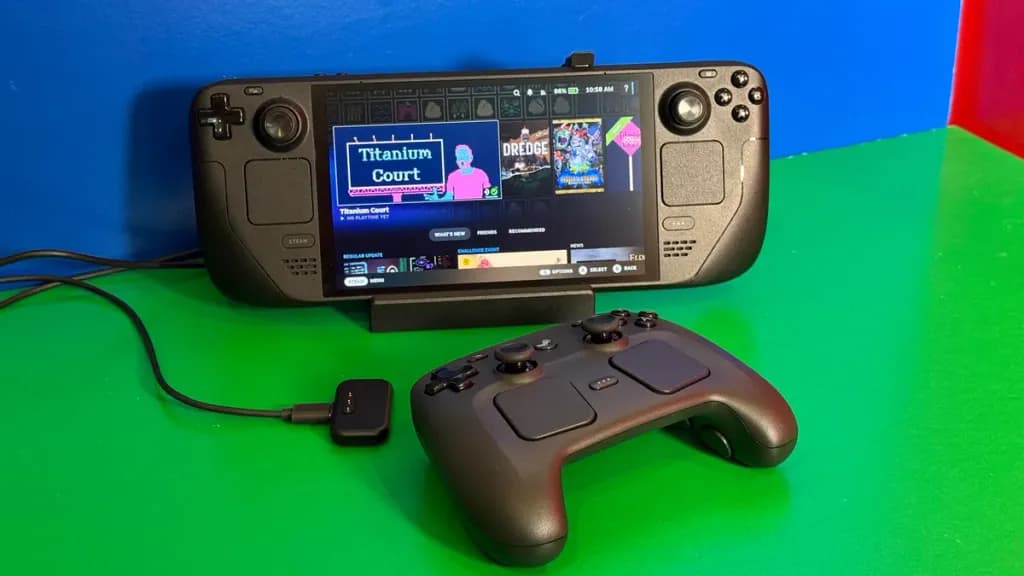
The return of the prodigal son: Why the Steam Controller 2 is shaking up the industry
A decade ago, Valve attempted a bold experiment with its first Steam Controller. It was a product ahead of its time: divisive, yet visionary. Today, in May 2026, Gabe Newell and his teams are finally breaking their silence. The Steam Controller (2026) is not just a simple revision; it is a statement of intent: Valve wants to take full control of the PC gaming experience and, by extension, SteamOS.
Haptic technology that changes the game
What strikes you immediately with this new version is not so much the design—which adopts the ergonomic standards validated by the Steam Deck—but its internal engine. Valve has integrated what they call "Neural Haptic Feedback". Unlike the classic vibrations of Xbox or PlayStation controllers, this controller uses high-frequency piezoelectric actuators capable of simulating not just shocks, but textures.
Imagine feeling the difference between tires screeching on damp asphalt and the surgical precision of reloading a firearm, all with millimeter-level accuracy. It is impressive, and after a few hours of testing, it is hard to go back to a traditional controller.
Technical specifications and promises
Valve is not cutting corners for its new flagship. Here is what is under the hood for this 2026 version:
- Connectivity: Bluetooth 5.4 with low latency and a proprietary "Steam Link Direct" dongle for near-zero latency.
- Trackpads: Two large high-resolution touchpads with capacitive pressure sensors.
- Triggers: Progressive Hall Effect triggers with motorized variable resistance.
- Battery Life: 60-hour built-in battery, rechargeable via USB-C in under an hour.
- Compatibility: Native with SteamOS and Windows via optimized Steam Input drivers.
The official price has been announced at 159 euros. A premium positioning that puts it in direct competition with the DualSense Edge from Sony and the Xbox Elite Series 3. It is expensive, certainly, but the build quality, combined with the unparalleled software integration of Steam, justifies this price for enthusiasts.
Expert review: A risky but necessary bet
As a tech journalist, I have seen dozens of "pro" controllers come and go. The Steam Controller (2026) stands out for its philosophy. Where competitors are content with adding back buttons or metal finishes, Valve seeks to change the way we interact with our games. The return of the trackpads, improved by years of feedback gathered on the Steam Deck, is a victory for strategy games and FPS titles that were previously unplayable on a controller.
However, the challenge remains the same as in 2015: the learning curve. It will take a few days for players to adapt to this precision, which differs from traditional analog sticks. But if you play on PC, love extreme customization via the Steam Input interface, and want the most technologically advanced hardware of the moment, this is the must-have purchase of 2026.
Valve is not trying to appeal to the general public who just want to play FIFA with a standard controller. They are aiming to conquer demanding gamers, those who want their peripherals to be as high-performing as their PC setup. With this launch, the Bellevue-based firm shows that it does not intend to stop at the success of the Steam Deck and wants to transform every point of contact with the player into a high-tech experience.