AI at your fingertips: OpenAI attempts the hardware adventure
Since the beginning of 2026, a persistent rumor had been swirling through the corridors of Silicon Valley. Would Sam Altman and his teams, accustomed to dominating the software landscape, cross the Rubicon into hardware? The answer is here: introducing the OpenAI Micro-keyboard. More than just an input device, this compact object positions itself as the essential physical interface for interacting with next-generation language models.
A minimalist design for maximum power
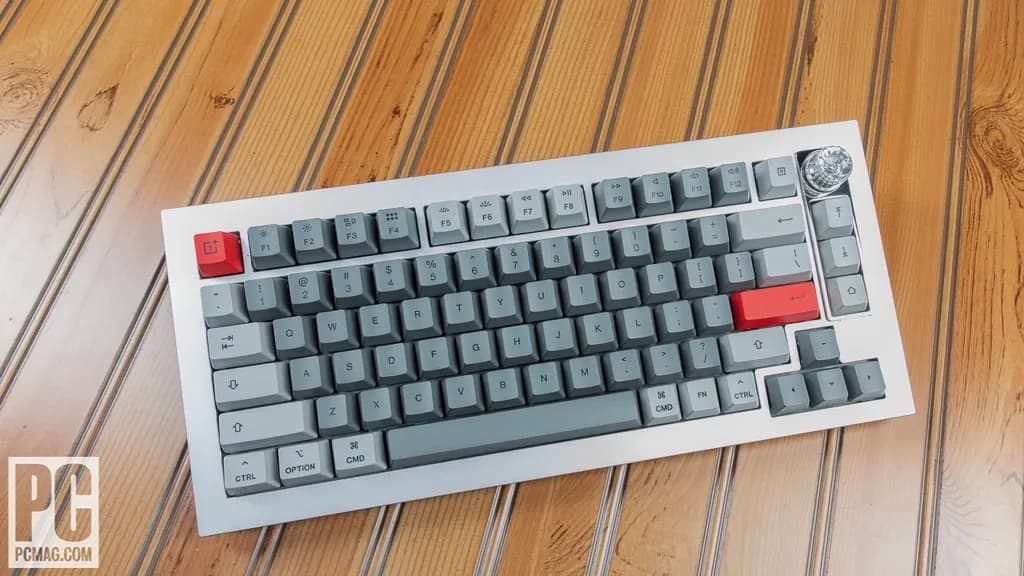
From the moment you pick it up, the conclusion is clear: this is not your typical gaming setup keyboard. With its compact dimensions – barely 20 cm wide – the OpenAI Micro-keyboard bets everything on contextual ergonomics. It features short-travel mechanical switches, but most importantly, a touch zone located under the space bar, dubbed the "O-Pad".
Key specifications:
- Connectivity: Ultra-low latency Bluetooth 6.0 (proprietary protocol).
- Interface: Haptic touch pad with adaptive force feedback.
- Integrated AI: Dedicated coprocessor for local processing of voice recognition and "Prompt-to-Key" commands.
- Battery life: 3 months with induction charging integrated into the mousepad.
Expert verdict: Is the revolution here?
As an industry observer, I am conflicted. On one hand, OpenAI's promise is seductive: to reduce the friction between thought and execution. Thanks to the dedicated "Neural-Sync" button, the keyboard learns your language habits and automates the correction of your prompts in real time. It is stunningly efficient. If you write a lot of code or long texts, the time savings are real.
However, the price makes you wince. With an announced price of 249 €, OpenAI positions itself in the premium segment, facing giants like Logitech's MX series or custom mechanical keyboards from Keychron. The OpenAI Micro-keyboard does not aim to replace your full desktop keyboard, but to complement your workflow. Is it a gadget? For the general public, probably. For prompt engineers and intensive creators, it is a piece of equipment that will quickly become essential.
Facing the competition: The battle of the AI interface
OpenAI is not alone in this arena. Google is actively preparing its response with a range of "Gemini-Ready" peripherals expected by late 2026, and several startups are betting on smart rings or lightweight neural interfaces. The challenge for OpenAI will be to convince users that hardware is the best vector for their artificial intelligence. For now, the build quality is there, and the integration with the latest GPT-5 model is, let's say, fluid to the point of being unsettling.
In conclusion, this Micro-keyboard is a statement of intent. OpenAI wants to be present wherever you work. If you have the budget and your daily life is punctuated by interactions with AI, it is an investment you will likely not regret.