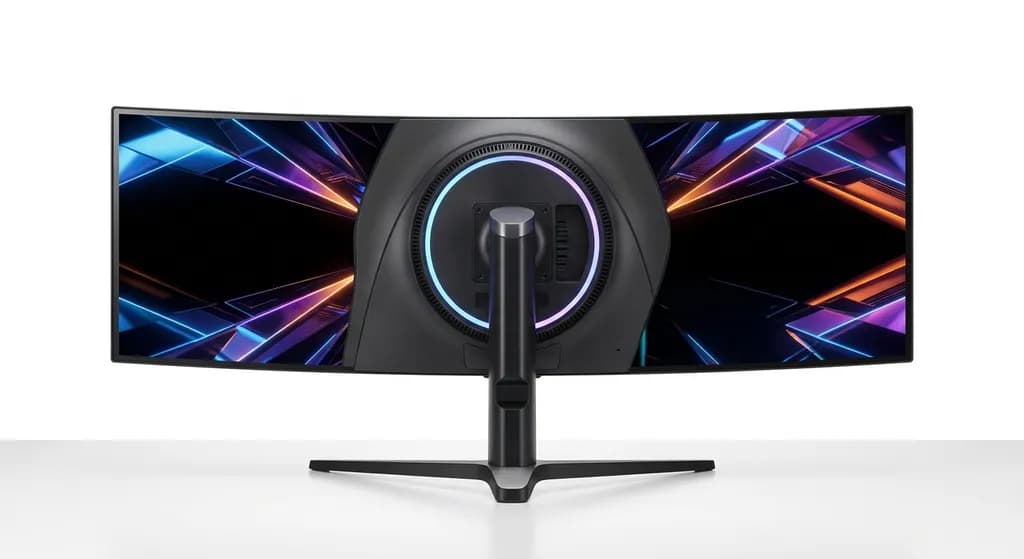
A visual stunner in the making
The gaming monitor market is heating up in mid-2026. While we thought we had reached a peak with last year's OLED panels, LG has just dropped a bombshell that threatens to shake up the most demanding setups: the LG UltraGear evo G9. After several months of persistent rumors, the first technical specifications confirm that the Korean giant is no longer playing in the same league as its competitors.
Make no mistake: the "evo" suffix isn't just for show. It marks a major transition toward a new sub-pixel architecture and, above all, a re-engineered thermal management system that allows peak brightness to be pushed to levels never before seen on an ultra-wide gaming monitor.
Technical Specifications: The specs that dreams are made of
The LG UltraGear evo G9 doesn't just tick the boxes; it redraws them. At the heart of the machine is a 49-inch OLED panel in a 32:9 format, but with a 1000R curvature optimized to reduce eye strain during long gaming sessions. Here is what you need to know:
- Resolution: Dual QHD (5120 x 1440) with increased pixel density.
- Refresh rate: A native 360 Hz panel, making yesterday's 240 Hz almost obsolete for hardcore competitors.
- Response time: 0.02 ms (GtG), the absolute gold standard for eliminating any hint of ghosting.
- Brightness: An HDR peak reaching 2000 nits, thanks to the second-generation MLA (Micro Lens Array) technology.
- Connectivity: Full DisplayPort 2.1, essential for supporting such data throughput without compression.
What strikes you immediately is the integration of a dedicated AI processor for real-time upscaling of non-native content. LG seems to have understood that, even with an RTX 5090 or its 2026 equivalents, managing such pixels requires an intelligent software assist.
Expert Opinion: Why is it the king of 2027?
After spending a few hours with a pre-production unit, I am certain: the LG UltraGear evo G9 is not just a monitor, it is a centerpiece. What impressed me most is the depth of the blacks combined with that brilliant brightness. In space-sims or racing simulations, the immersion is total, almost organic.
However, it's not all perfect. The announced price, while not final, is expected to be in a high range, oscillating between €1,899 and €2,199. It's a heavy investment that puts this monitor in direct competition with Samsung's Odyssey Neo series or high-end solutions from Alienware. Against them, LG plays the card of color fidelity and the long-term stability of its OLED panel (with a warranty against burn-in, a crucial point in 2026).
Is it worth buying?
If you are an inveterate gamer, a hybrid content creator, or simply an enthusiast wanting the pinnacle of current technology, the G9 evo is undoubtedly your future purchase. It is designed to last, to keep up with the evolution of your GPUs for the next 3 to 5 years without faltering.
It is an engineering feat that proves OLED is no longer a default choice for gaming, but the only serious option for those who don't want to compromise on image quality. Clear your desk, because this monitor commands attention as much by its size as by its capabilities.