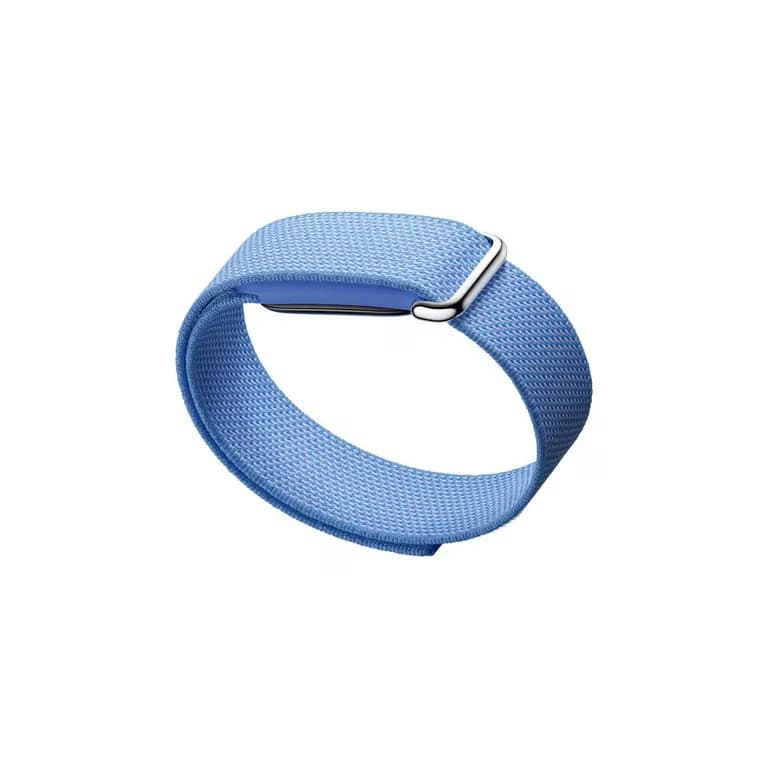
The bet on lightness by Google
Since the acquisition of Fitbit, Google has been navigating a middle path: turning its products into extensions of its Pixel smartphones or preserving the brand's pure health DNA. With the announcement of the Fitbit Air this May 2026, the Mountain View firm seems to have made its choice. The Fitbit Air is not just another smartwatch overloaded with useless features. It is a return to basics, a minimalist accessory, almost invisible, designed to be forgotten on the wrist while capturing vital data with surgical precision.
A design that clears the slate
The first thing that strikes you about the Fitbit Air is its total absence of a traditional screen. Google has opted for a bold approach: a capacitive touch surface covered in a textured polymer that incorporates discreet LED indicators beneath the surface. The goal is clear: to limit digital distraction. Goodbye incessant notifications, hello continuous wellness tracking. The chassis is ultra-thin, composed of a recycled aluminum alloy, making it, as the name suggests, the lightest wearable ever produced by Google.
Artificial intelligence serving the body
This is where the magic happens. The Fitbit Air does not just count your steps. Thanks to the deep integration of Gemini Nano, the sensor processes your biometric data locally. The bracelet learns from your sleep cycles, your heart rate variability (HRV), and even your daily stress peaks to offer proactive recovery recommendations. Unlike the 2024 or 2025 models, the Fitbit Air is capable of detecting the onset of accumulated fatigue before you even feel it. It is a "predictive health" approach that puts Google in the lead against competitors like Garmin or Oura.
Technical specifications and battery life
The Fitbit Air focuses on energy efficiency. With its low-power LED screen and highly optimized OS, Google promises 10 full days of battery life with 24/7 health tracking enabled. In terms of sensors, we find an improved version of the EDA (electrodermal activity) sensor and a next-generation SpO2 monitor. The launch price is announced at 179 €, an aggressive positioning to capture the audience moving away from overly intrusive smartwatches.
Expert opinion: Why is this a turning point?
As a sector observer, I am often annoyed by the arms race of technology on our wrists. More pixels, more apps, more distractions. The Fitbit Air heads in the opposite direction. In 2026, the trend is toward voluntary disconnection. Users want to know how their body is doing without sacrificing their mental health to the tyranny of notifications. If Google manages to keep the promise of a smooth, bug-free interface, the Fitbit Air could well become the reference product of the year. Against the Withings ScanWatch 3 or the future Oura Ring Gen 5, Google provides the software ecosystem that its more specialized competitors often lacked.
Direct competitors in 2026
The market is tough. The Fitbit Air will have to face:
- Oura Ring Gen 5: For those who prefer the ring format.
- Garmin Vivosmart 6: The historic king of sports tracking.
- Withings ScanWatch 3: For its hybrid horological aesthetic.
In conclusion, this Fitbit Air is a breath of fresh air. It is an honest, well-thought-out device that doesn't try to be your smartphone, but simply your best ally in understanding your health. I am eager to test it in the field, especially to see if the integration of Gemini can truly transform our sleep habits. One thing is certain: in 2026, simplicity has become the new luxury.