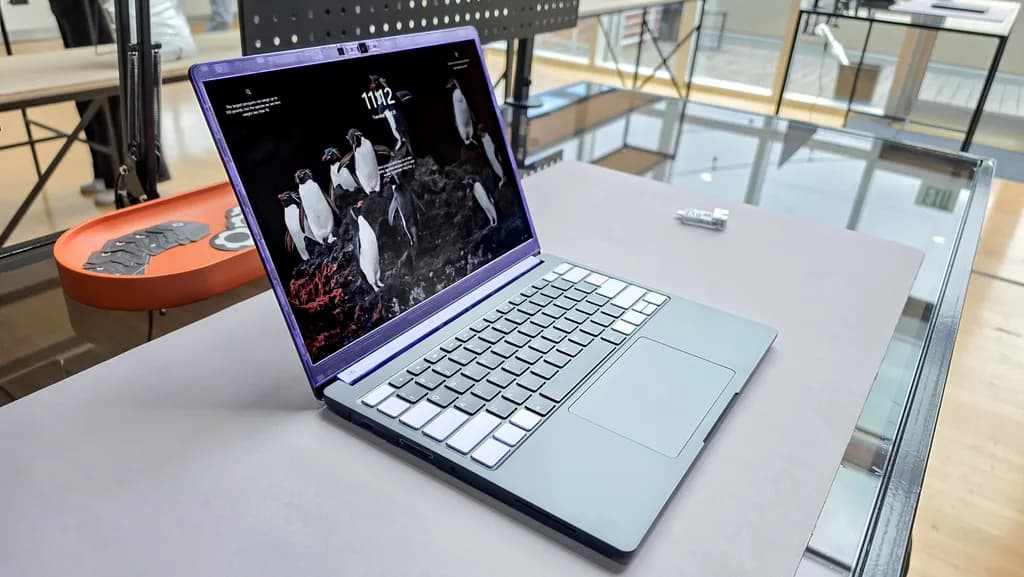
The spearhead of repairability finally arrives in a Pro version
For years, the tech community has watched Framework with admiration. The idea was simple, almost revolutionary in an industry obsessed with disposable design: build a computer that actually belongs to you. In May 2026, the company reached a crucial milestone with the official launch of the Framework Laptop 13 Pro. This is no longer just a machine for tinkerers or open-source purists; it is a product aimed at the high-end market, without compromise.
After spending a few days with the machine in hand, the conclusion is clear: Framework has understood that to convince the general public, it didn't just need to be ethical, it needed to be excellent.
High-performance internals
The Framework Laptop 13 Pro is no slouch when it comes to technical specifications. Under the hood, we find the latest next-generation 2nm chips, offering a striking balance between energy efficiency and raw power. Paired with ultra-fast LPDDR6 RAM, multitasking is exemplarily fluid. But what stands out most is the integration of the 120Hz OLED panel. Finally, Framework offers a display that rivals the best MacBook and XPS models on the market in terms of colorimetry and contrast.
Repairability vs. Performance: The dilemma solved
For a long time, critics claimed you couldn't have an ultra-high-performance and ultra-repairable laptop. The recycled aluminum chassis of the 13 Pro proves otherwise. The expansion card system, the brand's signature, has been slightly refined to allow for better thermal dissipation, crucial for modern processors that heat up as soon as they are pushed a little too hard.
The big novelty of this Pro version lies in the increased modularity of the motherboard itself. You no longer just change the ports; you can now upgrade the CPU/GPU block without having to buy a whole new machine, a fulfilled promise that finally validates the concept of the "sustainable PC" for 2027 and beyond.
The competition falters
Facing it, the 13 Pro finds tough adversaries. The 14-inch MacBook Pro remains untouchable for pure battery life, while Dell's XPS ranges maintain a lead on extreme screen bezel compactness. Yet, the Framework wins on a ground where giants fail: freedom. At a starting price estimated at $1,599 for the base configuration (excluding OS), it intelligently positions itself in the premium segment, while offering a much more advantageous long-term cost of ownership thanks to the durability of its components.
My expert opinion
Should you buy it? If you are a creative professional, a developer, or simply someone tired of seeing their PC become obsolete after three years, the answer is yes. The Framework Laptop 13 Pro is not just a computer, it is a manifesto. It is proof that in 2026, we can still truly own our technology. The finish is exemplary, the keyboard is a joy to type on, and most importantly, I know that if something goes wrong, I won't be trapped by a repair service that will charge me the price of a new device to replace a simple USB port. It is, in my opinion, the smartest purchase of the year.